Spaced repetition, explained: why cramming fails and what to do instead
The forgetting curve is brutal — within a week you lose most of what you crammed. Spaced repetition turns that curve into your ally. Here is how it works and how to use it.
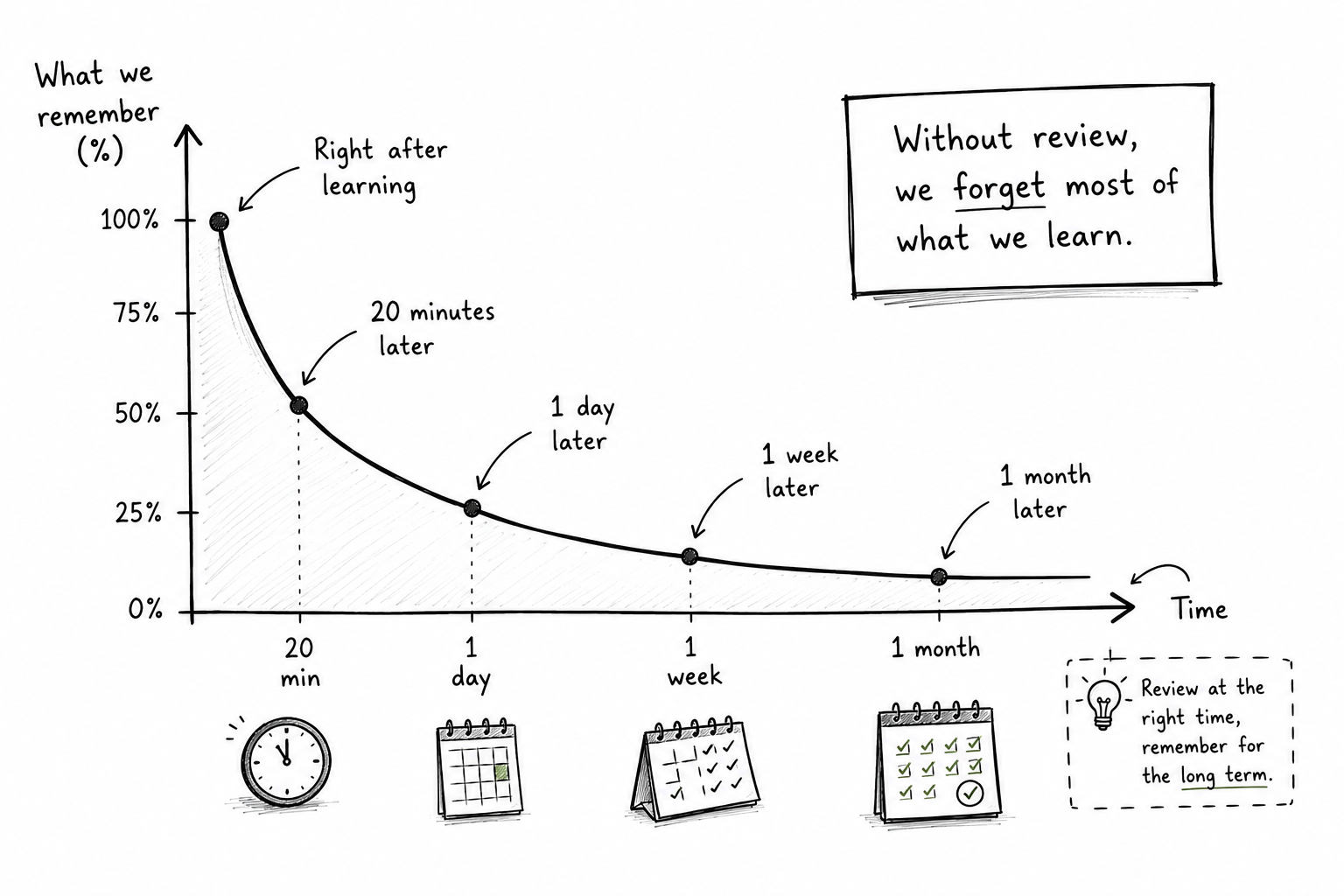
Hermann Ebbinghaus mapped the forgetting curve in 1885, and the news has not improved since: without review, you forget roughly half of new material within a day and most of it within a week. Cramming feels productive because everything is briefly in working memory — but it decays before exam day.
The science in one paragraph
Every time you successfully recall something just as you are about to forget it, the memory trace strengthens and the next forgetting cycle gets longer. Review a fact after one day, then three, then seven, then twenty-one — and by the fourth review it can survive for months. That is spaced repetition: scheduling reviews at expanding intervals, timed to your personal forgetting curve.
Why it beats massed practice
A landmark meta-analysis by Cepeda and colleagues found spacing improves long-term retention dramatically compared with massed study of the same total duration. The effort you feel when recalling something half-forgotten is the point — psychologists call it desirable difficulty. Easy reviews teach you nothing; effortful recall rebuilds the memory stronger.
How to actually do it
- Turn material into prompts. Questions, not summaries. "What are the three functions of the hippocampus?" beats a highlighted paragraph.
- Grade yourself honestly. Whether a card comes back tomorrow or next month should depend on how confidently you recalled it.
- Review daily, briefly. Ten minutes every morning beats ninety minutes on Sunday.
- Trust the schedule. Re-reviewing cards you already know feels safe but wastes the time the algorithm just saved you.
Where StudyOS fits
StudyOS generates flashcards from your own course materials and schedules them with confidence-based spacing. Swipe "Again", "Almost" or "Got it" and each card finds its own interval. Your mastery ring fills as the schedule does its work — no spreadsheet, no guesswork.
Start six weeks before an exam and the maths is delightful: a few minutes a day compounds into recall that survives the exam hall, the summer, and beyond.
Put this into practice
StudyOS turns your own course materials into flashcards, quizzes, practice exams and a study plan — all grounded in the science above.
Create your free account